
Lincoln Navigator: Body Closures / Fuel Filler Door. Removal and Installation
Removal
-
Open the fuel filler door.
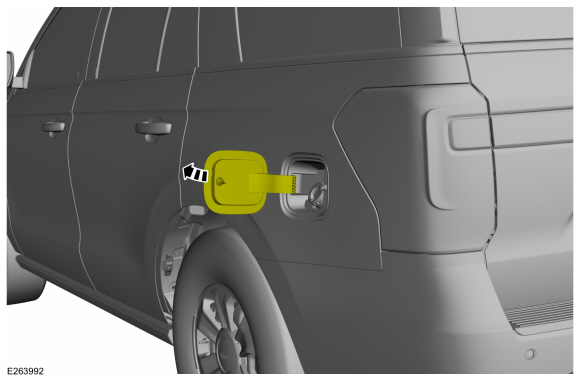 |
-
Using a screwdriver, push the retaining tab and slide the fuel filler door and remove.
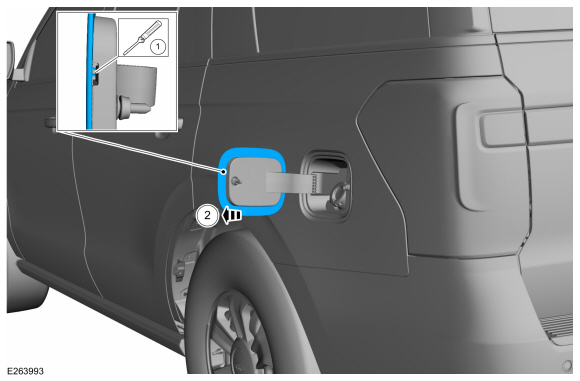 |
Installation
-
To install, reverse the removal procedure.
 Front Door Weatherstrip. Removal and Installation
Special Tool(s) /
General Equipment
Interior Trim Remover
Removal
NOTE:
Removal steps in this procedure may contain installation details...
 Fuel Filler Door Assembly. Removal and Installation
Special Tool(s) /
General Equipment
Flat Headed Screw Driver
Knife
Removal
NOTE:
Removal steps in this procedure may contain installation details...
Other information:
Lincoln Navigator 2018-2026 Workshop Manual: Seatbelt Maintenance. General Procedures
Inspection WARNING: All seatbelt components must be inspected and corrected as part of any collision repair. Inspect all seatbelt components as prescribed by Seatbelt Procedure After a Collision found in Section 501-20A General Procedures of this manual...
Lincoln Navigator 2018-2026 Workshop Manual: Cowl Side Panel. Removal and Installation
Special Tool(s) / General Equipment 6.5 mm Drill Bit 11 mm Drill Bit Rivet Gun Self-Piercing Rivet (SPR) Remover/Installer Belt Sander Hot Air Gun 8 mm Drill Bit Locking Pliers Materials Name Specification Metal Bonding AdhesiveTA-1, TA-1-B, 3M™ 08115, LORD Fusor® 108B, Henkel Teroson EP 5055 - ..
Categories
- Manuals Home
- 4th Gen Lincoln Navigator Service Manual (2018 - 2026)
- Liftgate Trim Panel. Removal and Installation
- Transmission Fluid Drain and Refill. General Procedures
- Front Seat. Removal and Installation
- Rear View Mirrors - System Operation and Component Description. Description and Operation
- Telematics Control Unit (TCU) Module. Removal and Installation
Wheel to Hub Runout Minimization. General Procedures
Check
NOTE: Wheel-to-hub optimization is important. Clearance between the wheel and hub can be used to offset or neutralize the Road Force® or run-out of the wheel and tire assembly. For every 0.001 inch of wheel-to-hub clearance, the Road Force® can be affected between 1 and 3 pounds depending on the tire stiffness.
NOTE: The example below illustrates how the clearance between the wheel and the hub can be used to offset the high spot of radial run-out or Road Force®. Following the procedure will make sure of the best optimization.
Position the wheel and tire assembly on the vehicle so that the high spot location of radial run-out or Road Force® is at the 6 o'clock position and