
Lincoln Navigator: Rear Climate Control / Rear Thermostatic Expansion Valve. Removal and Installation
Removal
NOTICE: During the removal or installation of components, cap, tape or otherwise appropriately protect all openings and tubes/fittings to prevent the ingress of dirt or other contamination. Remove caps, tape and other protective materials prior to installation.
NOTE: Removal steps in this procedure may contain installation details.
-
With the vehicle in N , position it on a hoist.
Refer to: Jacking and Lifting (100-02 Jacking and Lifting, Description and Operation).
-
Recover the refrigerant. Refer to the appropriate Recovery procedure in Group 412.
-
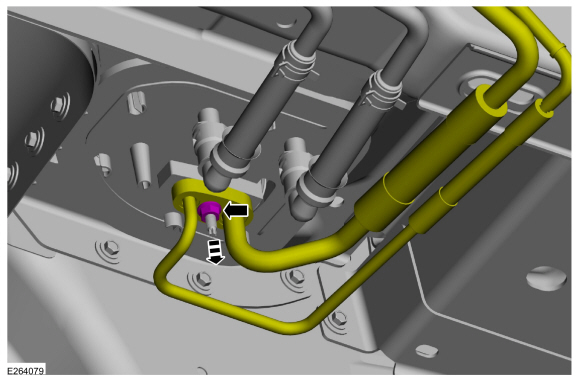
Remove the nut and position the rear thermostatic expansion valve manifold and tube assembly aside.
-
Make sure to cover any open ports to prevent debris from entering the system.
Torque: 159 lb.in (18 Nm)
-
Make sure to cover any open ports to prevent debris from entering the system.
 |
-
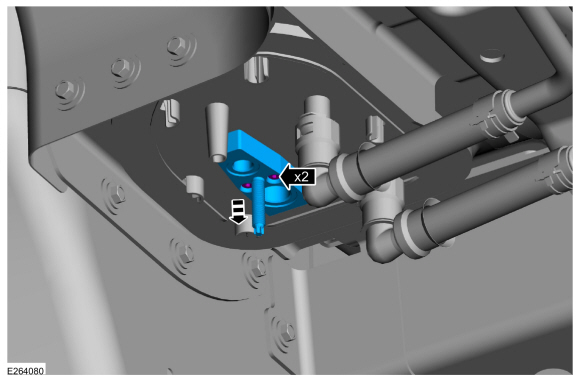
Remove the bolts and the rear thermostatic expansion valve.
-
Make sure to cover any open ports to prevent debris from entering the system.
Torque: 71 lb.in (8 Nm)
-
Make sure to cover any open ports to prevent debris from entering the system.
 |
Installation
-
To install, reverse the removal procedure.
-
NOTICE: Only use the specified material to lubricate the seals.
Install and lubricate new O-ring seals. Refer to the appropriate Specifications in Group 412.
-
Lubricate the refrigerant system with the correct amount
of clean PAG oil. Refer to the appropriate Refrigerant Oil Adding
procedure in Group 412.
 Rear Temperature Sensor. Removal and Installation
Removal
NOTE:
Removal steps in this procedure may contain installation details.
Lower the headliner.
Refer to: Headliner - Lowering (501-05 Interior Trim and Ornamentation, Removal and Installation)...

Other information:
Lincoln Navigator 2018-2026 Workshop Manual: Differential Carrier - Vehicles With: Electronic Limited-Slip Differential. Disassembly and Assembly
Special Tool(s) / General Equipment Punch Copper Hammer DISASSEMBLY NOTE: The eLSD hydraulic actuator LH RH case, clutch pack assembly, and HCU are only available with the differential carrier assembly. Remove the hydraulic actuator assembly from the differential case. Refer to: Hydraulic Actuator (205-02 Rear Drive Axle/Differential - Vehicl..
Lincoln Navigator 2018-2026 Workshop Manual: Battery. Diagnosis and Testing
General Equipment Diagnostic Battery Charger Use Ford approved battery test equipment listed in the Ford Warranty and Policy Manual. Diagnostics in this manual assume a certain skill level and knowledge of Ford-specific diagnostic practices. REFER to: Diagnostic Methods (100-00 General Information, Description and Operation). Diagnostic Trouble Code (DTC) Chart..
Categories
- Manuals Home
- 4th Gen Lincoln Navigator Service Manual (2018 - 2026)
- Transmission Fluid Drain and Refill. General Procedures
- Head Up Display (HUD) Module Calibration. General Procedures
- Telematics Control Unit (TCU) Module. Removal and Installation
- Rear Bumper. Removal and Installation
- All Terrain Control Module (ATCM). Removal and Installation
Rear Camber Adjustment. General Procedures
Special Tool(s) / General Equipment
Wheel Alignment SystemActivation
NOTICE: Suspension fasteners are critical parts that affect the performance of vital components and systems. Failure of these fasteners may result in major service expense. Use the same or equivalent parts if replacement is necessary. Do not use a replacement part of lesser quality or substitute design. Tighten fasteners as specified.
Using alignment equipment and the manufacturer's instructions, measure the rear camber.Use the General Equipment: Wheel Alignment System
