
Lincoln Navigator: Rear Suspension / Lower Trailing Arm. Removal and Installation
Removal
NOTICE: Suspension fasteners are critical parts that affect the performance of vital components and systems. Failure of these fasteners may result in major service expense. Use the same or equivalent parts if replacement is necessary. Do not use a replacement part of lesser quality or substitute design. Tighten fasteners as specified.
-
Remove the wheel and tire.
Refer to: Wheel and Tire (204-04A Wheels and Tires, Removal and Installation).
-
-
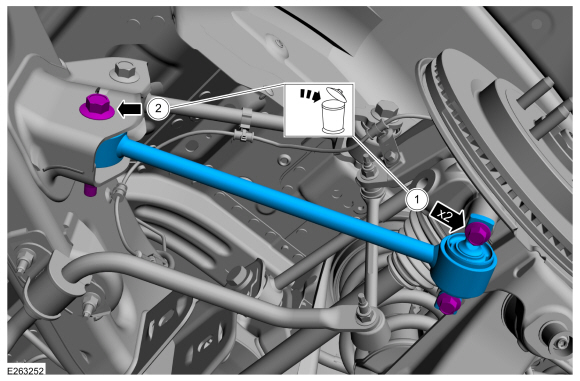
Remove and discard the 2 lower trailing arm-to-wheel knuckle bolts.
-
Remove and discard the lower trailing arm-to-frame bolt and flagnut and remove the trailing arm.
-
Remove and discard the 2 lower trailing arm-to-wheel knuckle bolts.
 |
Installation
-
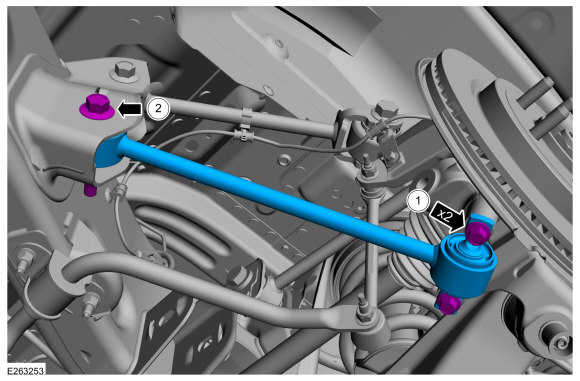
NOTE: Only tighten the nut and bolts finger tight at this stage.
-
Install the 2 new lower trailing arm-to-wheel knuckle bolts.
-
Install the lower trailing arm and install the new lower trailing arm-to-frame bolt and flagnut.
-
Install the 2 new lower trailing arm-to-wheel knuckle bolts.
 |
-
Install the wheel and tire.
Refer to: Wheel and Tire (204-04A Wheels and Tires, Removal and Installation).
- Lower the vehicle so that the weight of the vehicle is on the wheel and tire assemblies.
-
-
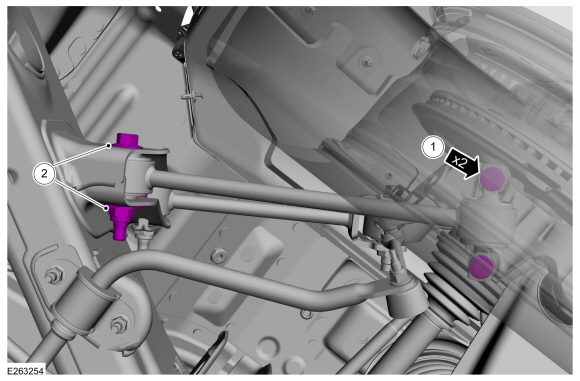
Tighten the 2 new lower trailing arm-to-wheel knuckle bolts.
Torque: 76 lb.ft (103 Nm)
-
Tighten the new lower trailing arm-to-frame bolt and flagnut.
Torque: 203 lb.ft (275 Nm)
-
Tighten the 2 new lower trailing arm-to-wheel knuckle bolts.
 |
 Lower Arm. Removal and Installation
Special Tool(s) /
General Equipment
204-592/1Adapter for 204-592
Removal
NOTICE:
Suspension fasteners are critical parts that affect the
performance of vital components and systems...
 Rear Stabilizer Bar. Removal and Installation
Removal
NOTICE:
Suspension fasteners are critical parts that affect the
performance of vital components and systems. Failure of these fasteners
may result in major service expense...
Other information:
Lincoln Navigator 2018-2026 Workshop Manual: Front Seat. Removal and Installation
Removal WARNING: The following procedure describes critical repair steps required for correct seat component installation. Follow all notes and steps carefully. Do not place any objects between the seat components and the body of the vehicle, nor any objects within a joint internal to the seat structure...
Lincoln Navigator 2018-2026 Workshop Manual: Parking Aid - System Operation and Component Description. Description and Operation
System Operation Parking Aid - Audible NOTE: Refer to owner literature for additional details for the use and operation Parking Aid system. The available parking aid features are dependant on the vehicle trim level and options selected...
Categories
- Manuals Home
- 4th Gen Lincoln Navigator Service Manual (2018 - 2026)
- Body Control Module (BCM). Removal and Installation
- Windshield Washer Pump. Removal and Installation
- Front Seat. Removal and Installation
- Rear Bumper. Removal and Installation
- Brake Service Mode Activation and Deactivation. General Procedures
Rear Drive Axle and Differential. Diagnosis and Testing
Symptom Chart(s)
Diagnostics in this manual assume a certain skill level and knowledge of Ford-specific diagnostic practices.
REFER to: Diagnostic Methods (100-00 General Information, Description and Operation).
Symptom Chart - Differential
Symptom Chart - Differential
Condition Actions Axle overheating GO to Pinpoint Test A Broken gear teeth on the ring gear or pinion GO to Pi
