
Lincoln Navigator: Automatic Transmission - 10-Speed Automatic Transmission – 10R80 / D Clutch. Description and Operation
Overview
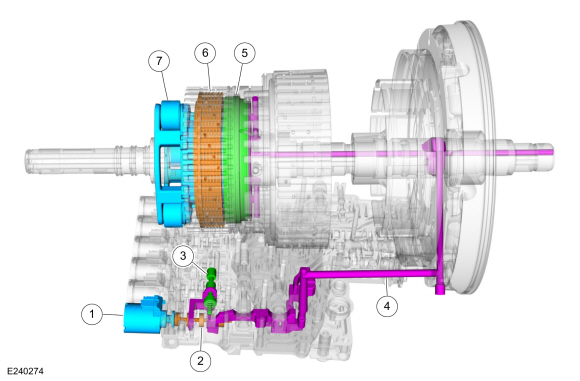
| Item | Description |
| 1 | SSD |
| 2 | D clutch control valve |
| 3 | Clutch gain control valve |
| 4 | D clutch apply circuit |
| 5 | D clutch piston |
| 6 | D clutch assembly |
| 7 | Planetary carrier No. 3 |
Planetary carrier No. 3 is located in the CDF clutch and planetary carrier assembly. Planetary carrier No. 3 is connected to the D clutch. When the D clutch applies, the planetary carrier No. 3 may be connected to ring gear No. 2.
D Clutch Exploded View
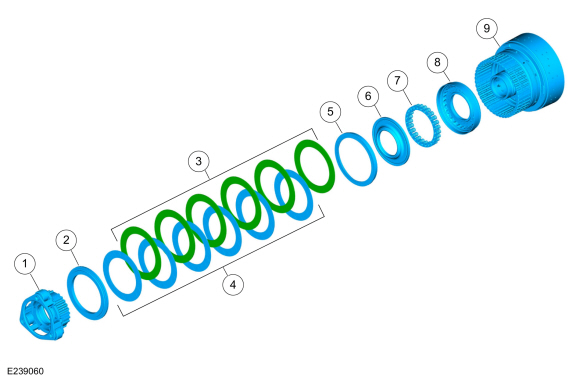
| Item | Description |
| 1 | Planetary carrier No. 3 |
| 2 | D clutch pressure plate |
| 3 | D clutch steel plates |
| 4 | D clutch friction plates |
| 5 | D clutch apply ring |
| 6 | D clutch balance dam |
| 7 | D clutch piston return spring |
| 8 | D clutch piston |
| 9 | CDF clutch cylinder |
D Clutch Hydraulic Circuits
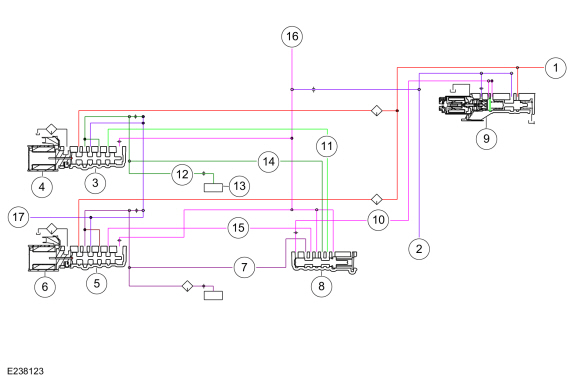
| Item | Description |
| 1 | Line pressure |
| 2 | Pump output |
| 3 | D clutch control valve |
| 4 | SSD |
| 5 | E clutch control valve |
| 6 | SSE |
| 7 | E clutch apply pressure to clutch gain control valve |
| 8 | Clutch gain control valve |
| 9 | LPC solenoid |
| 10 | LPC pressure |
| 11 | D clutch feedback pressure |
| 12 | Apply pressure to mechanical D clutch |
| 13 | Mechanical D clutch |
| 14 | D clutch apply pressure to clutch gain control valve |
| 15 | E clutch feedback pressure |
| 16 | Elevated exhaust pressure |
| 17 | Clutch exhaust |
D Clutch Hydraulic Operation 5th-6th Shift
Line pressure is supplied to the D clutch control valve. LPC pressure is supplied to the gain control valve. LPC pressure positions the gain control valve to the right end of the valve bore. As SSD turns on, it moves the D clutch control valve allowing regulated line pressure to flow to the mechanical D clutch.
D Clutch Hydraulic Operation 2nd-3rd, 4th-5th, and 9th-10th Shifts
Line pressure is supplied to the D clutch control valve. LPC pressure is supplied to the gain control valve. The LPC pressure is low and the gain control valve stays in the default position at the left end of the valve bore. As SSD turns on, it moves the D clutch control valve allowing regulated line pressure to flow to the mechanical D clutch.
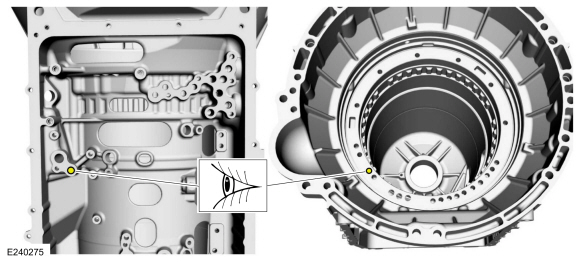
D Clutch Hydraulic Passages
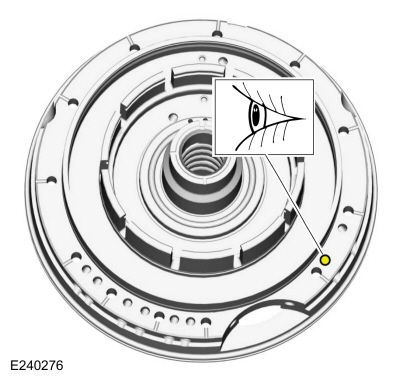
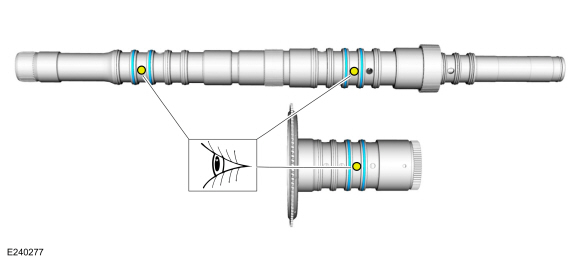
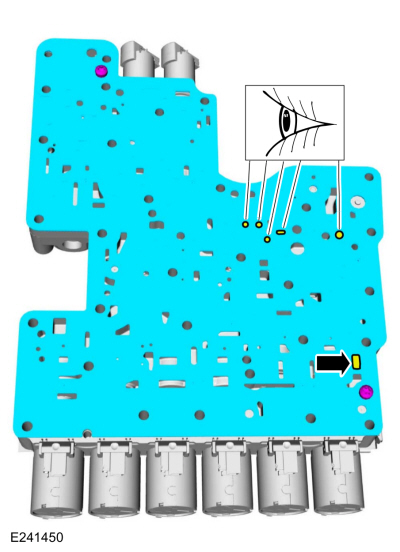

 E Clutch. Description and Operation
Overview
Item
Description
1
SSE
2
E clutch control valve
3
Clutch gain control valve
4
E clutch apply circuit
5
E clutch piston
6
E clutch assembly
7
Shell and sun gear..
Other information:
Lincoln Navigator 2018-2026 Workshop Manual: Coolant Pump. Removal and Installation
Special Tool(s) / General Equipment Hose Clamp Remover/Installer Materials Name Specification Motorcraft® Yellow Concentrated Antifreeze/CoolantVC-13-G WSS-M97B57-A1 Motorcraft® Orange Concentrated Antifreeze/CoolantVC-3-B WSS-M97B44-D Removal Drain the cooling system. Refer to: Engine Cooling System Drain..
Lincoln Navigator 2018-2026 Workshop Manual: Rear Stabilizer Bar. Removal and Installation
Removal NOTICE: Suspension fasteners are critical parts that affect the performance of vital components and systems. Failure of these fasteners may result in major service expense. Use the same or equivalent parts if replacement is necessary. Do not use a replacement part of lesser quality or substitute design. Tighten fasteners as specified. Remove the wheel and t..
Categories
- Manuals Home
- 4th Gen Lincoln Navigator Service Manual (2018 - 2026)
- Front Seat. Removal and Installation
- Transmission Fluid Drain and Refill. General Procedures
- Remote Function Actuator (RFA) Module. Removal and Installation
- Body Control Module (BCM). Removal and Installation
- Front Bumper Cover. Removal and Installation
Rear Drive Halfshafts. Diagnosis and Testing
Preliminary Inspection
Visually inspect the CV joints, housing, boots, and clamps for obvious signs of mechanical damage.If an obvious cause for an observed or reported concern is found, correct the cause (if possible) before proceeding to the next step
If the cause is not visually evident, verify the symptom and REFER to Symptom Chart: NVH.
