
Lincoln Navigator: Climate Control System - General Information / Air Conditioning (A/C) Compressor. Removal and Installation
Removal
NOTICE: If installing a new A/C compressor due to an internal failure of the old unit, carry out the following procedures to remove contamination from the A/C system. Failure to remove contamination from the A/C system, if present, will result in poor A/C performance and/or damage to the new A/C compressor and other components.
- If A/C flushing equipment is available, carry out flushing of the A/C system prior to installing a new A/C compressor.
- If A/C flushing equipment is not available, replace all contaminated components after a new A/C compressor has been installed.
- Install a new Thermostatic Expansion Valve (TXV) as directed by the A/C flushing.
- Install a new receiver drier element as directed by the A/C flushing.
NOTICE: During the removal of components, cap, tape or otherwise appropriately protect all openings to prevent the ingress of dirt or other contamination. Remove protective materials prior to installation.
NOTE: Installation of a new receiver drier element is not required when repairing the A/C system except when there is physical evidence of system contamination from a failed A/C compressor or damage to the receiver drier element.
NOTE: A new A/C compressor may come equipped with an A/C clutch disc and hub, A/C compressor pulley and A/C clutch field coil already installed. If these components are not pre-installed, it will be necessary to transfer these parts from the old A/C compressor to the new compressor prior to installation of the A/C compressor if suitable for reuse.
NOTE: Removal steps in this procedure may contain installation details.
-
Recover the refrigerant.
Refer to: Air Conditioning (A/C) System Recovery, Evacuation and Charging (412-00 Climate Control System - General Information, General Procedures).
-
Remove the RH air cleaner outlet pipe.
Refer to: Air Cleaner Outlet Pipe RH (303-12 Intake Air Distribution and Filtering - 3.5L EcoBoost (272kW/370PS), Removal and Installation).
-
Remove the RH
CAC intake pipe.
Refer to: Charge Air Cooler (CAC) Intake Pipe (303-12 Intake Air Distribution and Filtering - 3.5L EcoBoost (272kW/370PS), Removal and Installation).
-
Remove the A/C compressor belt.
Refer to: Air Conditioning (A/C) Compressor Belt (303-05 Accessory Drive - 3.5L EcoBoost (272kW/370PS), Removal and Installation).
-
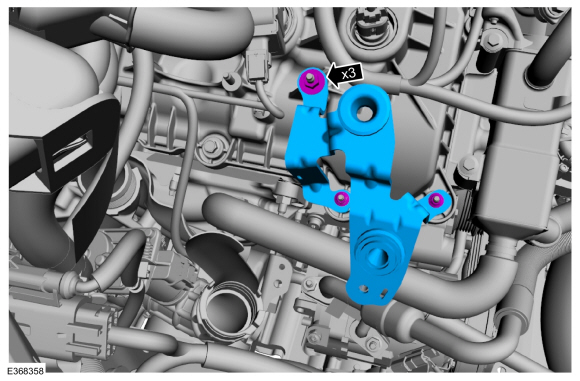
Remove the retainers and remove the support bracket.
Torque: 53 lb.in (6 Nm)
 |
-
Remove the battery tray.
Refer to: Battery Tray (414-01 Battery, Mounting and Cables, Removal and Installation).
-
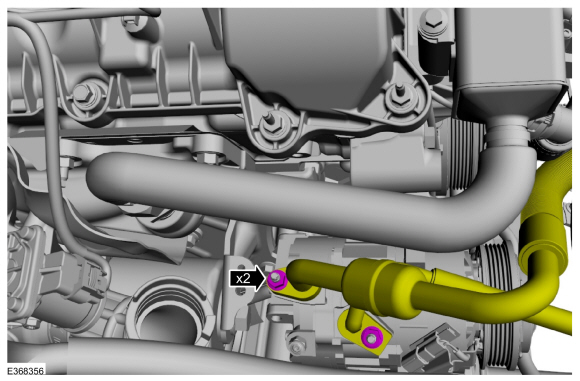
Remove the A/C compressor inlet and outlet line retainers and disconnect the fittings.
-
Make sure to cover any open ports to prevent debris from entering the system.
Torque: 133 lb.in (15 Nm)
-
Make sure to cover any open ports to prevent debris from entering the system.
 |
-
NOTE: Frame removed for clarity.
-
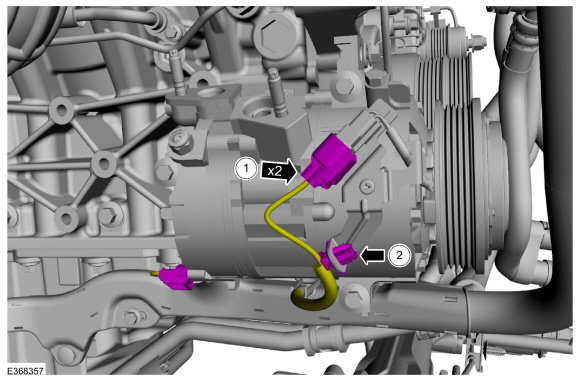
Disconnect the electrical connectors.
-
Detach the wiring harness retainer and position aside the wiring harness.
-
Disconnect the electrical connectors.
 |
-
NOTE: Frame removed for clarity.
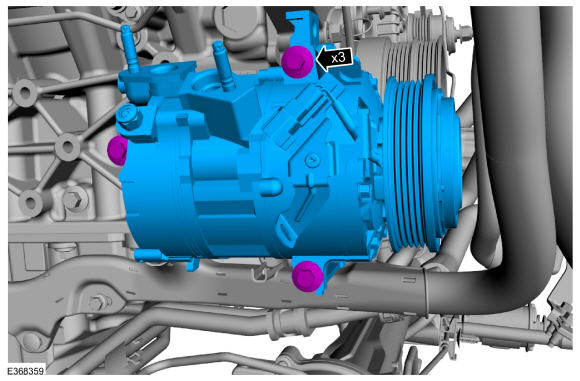
Remove the bolts and the A/C compressor.
 |
Installation
-
To install, reverse the removal procedure.
-
NOTE: Frame removed for clarity.
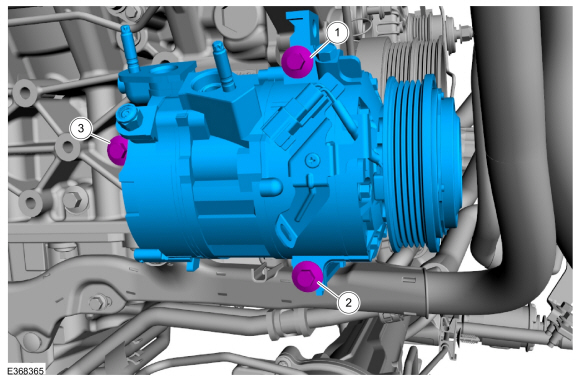
Tighten the A/C compressor bolts in the sequence shown.
Torque: 18 lb.ft (25 Nm)
 |
-
NOTICE: Only use the specified material to lubricate the seals.
Install and lubricate new O-ring seals. Refer to the appropriate.
Refer to: Specifications (412-00 Climate Control System - General Information, Specifications).
-
Lubricate the refrigerant system with the correct amount of clean PAG oil..
Refer to: Refrigerant Oil Adding (412-00 Climate Control System - General Information, General Procedures).
 Air Conditioning (A/C) Clutch and Air Conditioning (A/C) Clutch Field Coil. Removal and Installation
Special Tool(s) /
General Equipment
Snap Ring Pliers
Removal
NOTE:
Removal steps in this procedure may contain installation details...
 Air Conditioning (A/C) Compressor Inlet Line. Removal and Installation
Removal
NOTICE:
During the removal or installation of components, cap, tape
or otherwise appropriately protect all openings and tubes/fittings to
prevent the ingress of dirt or other contamination...
Other information:
Lincoln Navigator 2018-2026 Workshop Manual: Active Grille Shutter Actuator. Removal and Installation
Removal Upper active grille shutter actuator Remove the upper active grille shutter. Refer to: Active Grille Shutter (501-02 Front End Body Panels, Removal and Installation). Release the clips, and remove the linkage...
Lincoln Navigator 2018-2026 Workshop Manual: Second Row Seatbelt Buckle. Removal and Installation
Removal NOTE: Removal steps in this procedure may contain installation details. NOTE: Left-hand (LH) shown, right-hand (RH) similar. Remove the second row seat. Refer to: Second Row Seat (501-10B Second Row Seats, Removal and Installation)...
Categories
- Manuals Home
- 4th Gen Lincoln Navigator Service Manual (2018 - 2026)
- Transmission Fluid Drain and Refill. General Procedures
- Windshield Washer Pump. Removal and Installation
- Identification Codes. Description and Operation
- Telematics Control Unit (TCU) Module. Removal and Installation
- Remote Function Actuator (RFA) Module. Removal and Installation
Differential Case Runout Check. General Procedures
Special Tool(s) / General Equipment
 205-1016
Installer, Differential Bearing
TKIT-2014D-ROW2
TKIT-2014D-FL_ROW
 205-153
(T80T-4000-W)
205-153
(T80T-4000-W)
Handle
 205-D061
(D83T-4205-C2)
205-D061
(D83T-4205-C2)
Step Plate Dial Indicator Three Leg Puller Punch
